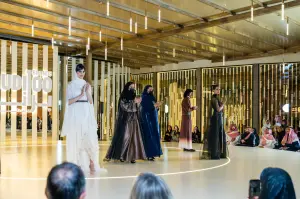
RIYADH — The world’s biggest horse events have always been about more than horses. At Royal Ascot and the Kentucky Derby, dressing up for the races is as much a tradition as the sport itself. Those events also did something else: They made the fashion of the countries they were held in visible to the world. Ascot has organized the dress for the British event; The Derby made American behavior stylish.
The Saudi Cup is doing the same thing in real time, and a new generation of Saudi designers is using it to redefine what heritage fashion can mean.
The annual event at the King Abdulaziz Racecourse in Riyadh and with a prize purse of 20 million dollars is the richest horse race in the world, attracting owners, trainers and racers from across the Gulf, Europe, the US and Asia.
Yet its influence on fashion goes deeper than mere appearance. It has created a global platform where wearing heritage is an expectation rather than an exception and a unique opportunity where Saudi designers are not asked to translate to external audiences because they are internal audiences.
Last month’s Saudi Cup 100 Brands showcase by the Saudi Fashion Commission made that argument visible. The exhibition is also supported by Saudi’s Fashion Futures program, which works with businesses, investors and others to identify trends and provide information and connections to help capture opportunities for companies in the country’s fashion and retail sectors.
Arwa Alsuhaim, co-founder of ready-to-wear label Enays alongside Njoud Alyousif, showed a collection that reflected the ancient trade routes that once carried Saudi goods across vast deserts to the Levant, Iraq and India. A “caravan,” consisting of six pieces, represented the various goods transported by those roads. The “Red Caravan” showcased the beauty of rubies with bright fiery red and burgundy fabrics. “Scent of the Journey” was about Arabian coffee, combining warm browns and golds with fluid lines that evoke the tradition of grinding and pouring. The strongest piece, “Neigh,” translated the elegance of the Arabian horse into strong lines and a palette of black, white and silver. Alsuhaim said: “Heritage doesn’t stand still. Instead of retelling it literally, we took it as a framework for a story.
Reema and Lama Almuhareb, co-founders of TheXO, approached the brief differently. Their brand, based on streetwear, approached the high cultural record of the event by using equestrian culture, not in images but in understanding. The result was flowing silhouettes that reflect movement, structured fabric held by belts, a balance between simplicity and construction that reflects the behavior of riding a horse itself. Reema said: “Heritage is often reduced to a visual perception, but I believe it is deeply there.” “Sometimes heritage emerges not in symbols, but in values, rhythms and cultural thought.”
Reema and Lama Almuhareb have stepped up their streetwear brand, TheXO, to create a look fit for the Saudi Cup.
Mohammed Sultan, the founder of Sulitude, took a very personal approach, building his collection around the dialogue between his region in the west of the Kingdom and the central region where he lives now. Textiles and images taken from the Hejaz were combined with the geometric sense of Najdi craftsmanship. He said: “These two places have different customs and traditions, but they have the same culture and spirit. It was a personal story translated into design.”

A glimpse from Sultitude’s performance at the Saudi Cup.
The jewelry and accessories show that ran along the runway added another dimension to the conversation. Notti, one of the Saudi brands exhibiting on both days, showed pieces that drew directly from the visual language of the region: statement earrings with gold-plated pendants that reflect the traditions of Arabian calligraphy, combined with carnelian, turquoise and pearl drops that felt based on craftsmanship rather than style. The work was obvious, a reminder that the debate on Saudi design heritage extends beyond clothing.
Saudi jewelry brand Notti.
Dressing Saudi Is A Statement
The creative power of the Saudi Cup show extends beyond the racetrack.
Noaf Alnamlah has been closely watching the Saudi fashion market for the past 15 years. A Riyadh-based stylist and fashion consultant who was the first senior stylist at Farfetch Saudi and worked closely with the Saudi 100 Brands program, he presents a contrast that gets to the heart of what is really going on.
When a Saudi woman chose a local designer over a European luxury label for a big event, Alnamlah said the statement was on purpose. “I’m talking about my good culture, that we have a lot of talented designers who can create things in a different way. I also say that modesty is also good.”
For a Saudi woman who spent years buying and wearing local brands, it was not a matter of not needing foreign approval from international retailers who carried local products. He said: “In the past, when other designers were not available, I liked to say that I wore a Saudi designer while traveling in Europe. I was contributing to introducing other cultures to my culture and my country’s designs.
The change that Alnamlah has seen recently is in terms of scale. “Many people have been going to Saudi designers for casual pieces and for big events, especially red carpets. You see international movie stars wearing Saudi designers for big events.” She said, recently, she was approached about dressing a Met Gala guest by a Saudi designer. “No wonder,” he said. “It’s strange, but not surprising.”
Saudi products are on the move
The clearest evidence that Saudi fashion’s international trend is real rather than predictable comes from tried-and-true brands.
Nora Aldamer, who reunited Kallyah with her sister Haifa, recently named Chador. The original brand had a strong identity built around modest luxury, but Aldamer realized that the women it was designed for had changed. “When we started Chador, the reality of women’s lives in Saudi Arabia was very different,” she said. “Now women are working, driving, walking across town, balancing careers, families and ambitions in ways that are both tangible and tangible.”
As a stylist, Alnamlah cited Kallyah among the Saudi labels with the most consistent international identity, saying the brand’s appeal is immediate. “I know it’s a piece of Kallyah when I see it.”
Aldamer said that consistency is the result of complete clarity about their customers. “The goal is to make the woman who wears it feel quietly confident, as if she carries a presence in the room without needing to announce it.”
He added: “For a long time, casual fashion has existed as something sought after without a well-thought-out design, especially in the luxury and contemporary environment.” Today it is more recognized that dressing modestly is not only important.
He said the aim is to show that self-respect does not end with creativity. “It can actually create a very refined, modern style of dressing.”
Abadia, founded by Shahd AlShehail and founded from the beginning of the handicraft traditions of the Arabian Peninsula – including sadu weaving and a commitment to keep the crafts alive – is sold abroad, and its culturally unique pieces have become actively sought after by international sellers.
But clearly, AlShehail doesn’t lead with the legacy argument – he leads with the product. “I’m a firm believer that product is king. I don’t think a story can live on its own without a strong product to back it up.” The depth of culture is real and present in everything Abadia does, but in his design it is an added feature rather than a foundation. “Some customers are just interested in a beautiful dress, and that’s what they’re going to get.
A look from Abadia fall 2025 at Riyadh Fashion Week.
Courtesy of Abadia
This is what AlShehail means when he says that craft is a universal language. “The idea that true luxury is about authenticity and authenticity and craftsmanship is part of our personal experience.”
International traders agreed. “Some of our sellers really want those products as the basis of what they want to offer to a global audience, because of the uniqueness and the return to real luxury and authenticity and craftsmanship.”
Beyond the Racecourse
Since many clothes are not only made, but are made inside the Kingdom, supporting Saudi workshops, artisans and factories, Saudi fashion has become more than a second in the development of the fashion industry. The newest generation of designers go both ways at the same time.
The Saudi Cup provides a platform where heritage clothing is the norm, giving designers the ability to show meaning without needing to explain themselves. As Saudi names become increasingly popular around the world and appear in categories where their traditional pronunciations are not always the norm, the reality check begins.
Reema explained clearly: “What’s happening in Saudi Arabia today is a rapidly changing creative scene with many different sounds and styles. It’s not just one story.
The desire is clear. “Enays’ goal is to become a globally recognized label,” Alsuhaim said, “that celebrates culture, empowers women, and tells meaningful stories through design.”
For a generation of designers using the Saudi Cup to develop a language strong enough to hold their own in Riyadh, London, Paris or New York, that is not a far-fetched aspiration.
Editor’s Note: For more information on Saudi fashion sectors and stores, subscribe to fashionfutures.com.
#Saudi #Designers #Write #Rules